
UNDERSTANDING LIVE RESPONSE
UNDERSTANDING MARS' APPROACH TO LIVE MARINE ANIMAL RESPONSE
Every response is unique. Every decision is guided by science, experience, animal welfare, safety, and the circumstances of the incident.
For many people, a live marine animal response is their first introduction to MARS.
When a whale strands on a beach, a seal is reported in distress, or a dolphin is trapped in shallow water, people naturally want to know what will happen next. They want to help, and they often expect that rescuing the animal is the only acceptable outcome.
The reality is far more complex.
Live marine animal response is one of the most visible and emotionally charged aspects of our work, but it represents only one part of MARS’ broader conservation mission. Response decisions are shaped by many interconnected factors—including animal welfare, public and responder safety, environmental conditions, scientific knowledge, operational feasibility, and legal requirements.
Because many of these considerations are not immediately visible, response decisions can sometimes be misunderstood or questioned.
OUR LIVE RESPONSE PHILOSOPHY
Marine animal response is about more than rescuing animals.
Our approach to live response seeks to identify an appropriate course of action for the particular animal and circumstances while protecting people, respecting legal responsibilities, and contributing to long-term conservation. Not every incident can be resolved in the same way. Some animals can be successfully returned to the wild. Others require monitoring, supportive care, humane euthanasia, or, in some situations, allowing nature to take its course.
Compassion is essential—but compassion alone cannot determine these decisions.
Every response must balance animal welfare, scientific knowledge, responder and public safety, operational feasibility, legal requirements, and the realities of each incident.
This philosophy guides every live response undertaken by MARS.
OUR CORE PRINCIPLES
Every live marine animal response is guided by a shared set of principles.
Every response is unique.
No two incidents are exactly alike. Every animal, location, and situation presents different challenges and opportunities. A response that is appropriate for one animal may not be appropriate for another, even if the situations appear similar.
No single consideration determines the response.
Live response decisions are never based on one factor alone. Multiple considerations are evaluated together before a response plan is developed and initiated.
Decisions are based on the best available information.
Information is often incomplete when a report is first received. As new information becomes available, our understanding—and sometimes our response—may change.
The goal is an appropriate response for the animal and the circumstances.
Not every incident has an ideal outcome. The course of action must reflect the realities of each situation.
Safety comes first.
The safety of responders and the public can never be compromised.
Compassion must be guided by science.
Our commitment to animal welfare is informed by scientific knowledge, professional expertise, and careful assessment—not emotion alone.
Live response is collaborative.
Effective response depends on trained responders, veterinarians, government agencies, volunteers, Indigenous communities, researchers, local partners, and members of the public working together.
Every response advances conservation.
Even when intervention is limited, every response contributes valuable knowledge that helps improve future responses and our understanding of marine wildlife.
THE LIVE RESPONSE PATHWAY
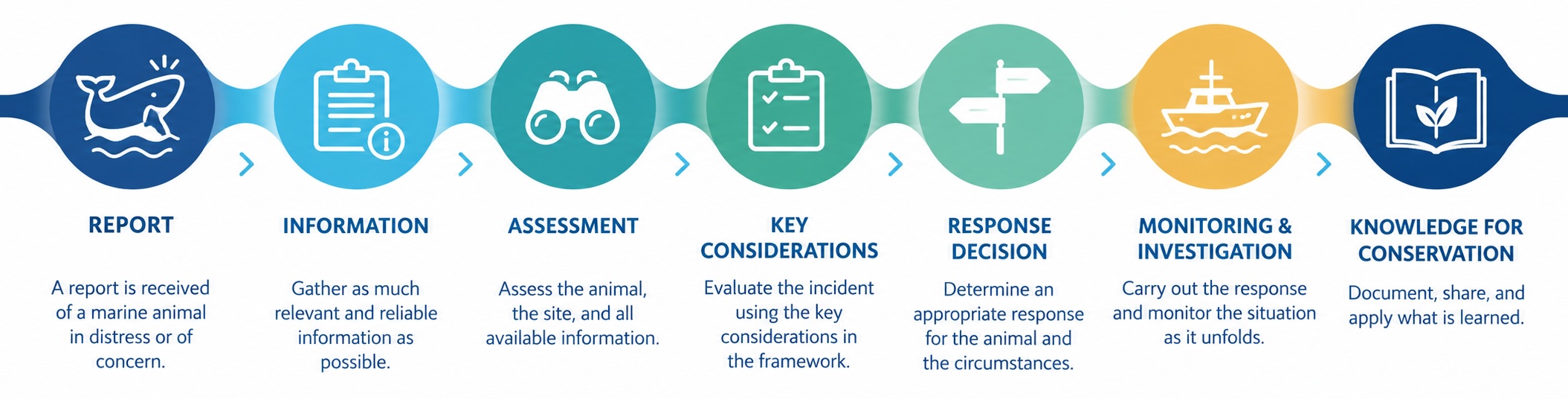
Every live marine animal report follows a structured decision journey. While no two incidents are the same, every response is evaluated using the same overarching process.
This helps ensure that responses remain consistent, transparent, and grounded in science, experience, and animal welfare.
THE KEY CONSIDERATIONS
Live response decisions are shaped by a number of interconnected considerations. No single consideration determines the response. These considerations are grouped into three categories:
Understanding the Animal
- Health and welfare
- Species biology
- Behaviour and social dynamics
Understanding the Situation
- Location
- Environmental conditions
- Public safety and human activity
Understanding the Response
- Responder safety
- Response feasibility
- Legal authorities and requirements
BEYOND THE RESPONSE
A live response does not end when an animal returns to the water—or when an incident concludes.
Every response contributes to something larger.
Where possible, MARS continues to monitor the situation, document what occurs, and gather information that can help us better understand the animal, the incident, and its outcome.
Information gathered during live responses helps improve future response techniques, supports scientific research, informs conservation decisions, strengthens partnerships, and expands our understanding of marine wildlife throughout the Maritimes and beyond.
While not every animal can be saved, every response has the potential to improve outcomes for future animals.
That is conservation in action.
FREQUENTLY ASKED QUESTIONS
It is natural to assume that every marine animal in distress should be rescued. In reality, rescue is only one of several possible outcomes.
Some animals can be successfully returned to the wild. Others may be too ill, too severely injured, or too compromised for intervention to improve their welfare. In some situations, attempting a rescue may actually prolong suffering or create additional risks for the animal, responders, or the public.
Every response begins with a central question:
What course of action is appropriate for this animal and the circumstances?
The answer is different for every incident.
Not necessarily.
For an animal that is stranded, getting it back into the water too quickly can sometimes do more harm than good.
Different species require different approaches to intervention, and what is appropriate for one animal may be ineffective—or even harmful—for another. Responders must first consider the species involved, the animal’s condition and behaviour, and the circumstances of the stranding before determining whether returning it to the water is appropriate.
For some animals, returning to the water may be part of the response. For others, monitoring, supportive care, or another course of action may be more appropriate.
A timely response is important, but a thoughtful response is even more important.
Every live response begins with the same question: what course of action is appropriate for the animal and the circumstances?
Hands-on intervention is only one of many possible response options. In some situations, it offers the animal the greatest chance of survival. In others, intervention may provide little benefit, create additional stress or suffering, or place responders and the public at unnecessary risk.
Monitoring is not the absence of a response—it is an active response strategy. By observing an animal over time, responders can assess its condition, behaviour, movement, and the surrounding environment before determining whether intervention is needed and, if so, what form it should take. In some cases, monitoring confirms that an animal is recovering on its own. In others, it provides the information needed to safely plan a future intervention or determine that another course of action is in the animal’s best interest.
Humane euthanasia is one of the most difficult decisions made during live response and is never undertaken lightly.
When an animal is suffering and recovery is unlikely, euthanasia may be the most humane course of action. However, the ability to carry out euthanasia safely and humanely varies considerably depending on the species, size of the animal, location, and circumstances of the incident.
Depending on the method required, specialized equipment, appropriately trained and legally authorized personnel, access to controlled substances, and suitable environmental conditions may all be needed. For very large animals, these requirements can make humane euthanasia particularly challenging under field conditions.
Every situation is carefully assessed to determine an appropriate response that prioritizes animal welfare and minimizes suffering.
The first information received about an incident is rarely the complete picture. As responders gather additional observations, photographs, videos, or conduct an on-site assessment, new information often changes our understanding of the situation.
Weather, tides, animal behaviour, environmental conditions, time, and changes in the animal’s physical condition can all affect what is possible, appropriate, or safe.
For this reason, response decisions are continually reassessed as new information becomes available.
Changing a response plan is not a sign of inconsistency—it reflects an evidence-based approach that adapts to the circumstances of each incident.
MARS assesses each incident and determines an appropriate course of action based on the best available information, established response protocols, and the circumstances of the incident.
Marine animal response is a regulated activity. MARS holds the federal permits and authorizations required to undertake specific response activities and works within the legislation and regulatory requirements that apply to each incident, including incidents involving species at risk. Depending on the situation, MARS may also consult and coordinate with veterinarians, Fisheries and Oceans Canada, Indigenous communities, researchers, and other agencies or partners.
Live response decisions are not based on the judgement of one person or one factor. They reflect a careful assessment of animal welfare, responder and public safety, environmental conditions, response feasibility, legal requirements, and the information available at the time.
Members of the public play a vital role in marine animal response. Many incidents are first reported by people who are out walking the beach, boating, fishing, or enjoying the coast.
The best way to help is to:
- Keep a safe distance from the animal.
- Keep people and pets away.
- Avoid attempting to move or return the animal to the water unless directed by trained responders.
- Take photographs or video if it is safe to do so.
- Report the animal to MARS as soon as possible and follow any guidance provided.
Your observations are often the first—and one of the most important—steps in helping a marine animal in need.
Absolutely. Effective marine animal response depends on trained people working together.
Responding to stranded, entangled, or injured marine animals requires specialized knowledge, practical skills, and, for many response activities, authorization from the appropriate federal authority. Training helps responders understand marine animal biology and behaviour, assess animal welfare, work safely around large wildlife, and apply response techniques appropriately. Training alone does not authorize someone to undertake activities that require permits, licences, or other legal authority.
MARS is working to expand training opportunities for volunteers and community members across the Maritime provinces. While training opportunities may vary throughout the year, our goal is to build a strong network of skilled volunteers who can support and participate in marine animal conservation throughout the region.
Visit our Volunteer page or contact us to learn more about current opportunities.
The conservation value of a response does not end when the incident concludes.
Information collected during live responses—including photographs, measurements, behavioural observations, environmental conditions, and other field data—helps improve future response techniques, supports scientific research, and contributes to a better understanding of marine wildlife in the Maritime provinces of Canada.
When an animal does not survive, additional investigation or a necropsy may also provide valuable information about health, disease, human impacts, or the causes of death.
Every response adds to the growing body of knowledge that can improve future marine animal response and inform overall ocean conservation.